


Foreigners often find document consular legalization for use in Vietnam confusing. The steps, procedures, and number of times asking questions for confirmation from the authority can easily make you overwhelmed. If possible, please allow FAQTrans to guide you through the consular legalization process in Vietnam and provide you with the fast and stress-free translation and notarization services for legalized foreign-issued documents.
What is consular legalization? Why do we need consular legalization?
What is consular legalization?
To put it simply, consular legalization is a process that verifies the stamp, signature, position and name of a signer and organization so that it can be legally approved by foreign authority. A consular legalization stamp does not confirm the accuracy of the document’s content. It only confirms that a duly authorized individual of a competent organization/agency has provided their seal, name, and signature.
Consular legalization vs Consular authentication
Sometimes, the term “consular legalization” and “consular authentication” are often used interchangeably, but there are still some differences between them. While consular legalization is the verification of foreign-issued documents for use in the host country, consular authentication is the verification of domestic-issued documents for use abroad.
That means if you want to use a document issued by foreign authority in Vietnam, such a document needs to be legalized first.

This article is aimed at people who want to legalize their foreign documents to be legally acknowledged by Vietnamese authorities
What documents often require consular legalization for use in Vietnam?
Common legalized documents for use in Vietnam
In Vietnam, foreigners are often asked to legalize the following documents:
- Birth Certificate/Certificate of Live Birth
- Medical Certificate
- Certificate of Marriage
- Certificate of Marital Status/Affidavit of Single Status
- Confirmation of Employment
- Company Charter/ Articles of Association
- Certificate of Criminal Record/Certificate of Good Conduct
- Contract
….
Depending on your purpose of stay (marriage, work, study or investment) in Vietnam, you will be required to submit the corresponding documents.
Do you have to legalize all documents for use in Vietnam?
One special thing about consular legalization for use in Vietnam is that not all documents require legalization stamps. According to Article 6 of Circular no. 01/2020/TT-BTP issued by the Ministry of Justice, documents exempted from consular legalization in Vietnam are:
- Passport
- Citizen Identity Card/ ID Card
- Permanent Residence Card
- Temporary Residence Card/ Residence Permit
- Driving License
- Diploma
- Degree
- Certificate
- Academic transcript/ Diploma Supplement/School Report
In other words, if you have to submit a Russian degree to get a job in Vietnam, you can simply have it translated into Vietnamese and notarized.
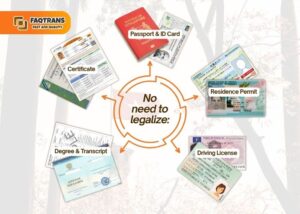
The documents above can be translated and notarized directly in any Vietnamese notary offices
What documents can be legalized for use in Vietnam?
Another thing you should know about consular legalization is that a document must meet certain requirements to be capable of being legalized. Such requirements can differ from country to country, but they generally include:
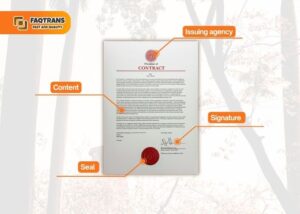
You cannot legalize any type of document. Pay attention to the issuing agency, content, seal, and signature of that document
Issuing agency
The issuing agency must be governmental bodies or competent organizations. Of course, forged papers are not on the list.
- For copy/translation: Must first be certified by an authority (eg: a notary office) before legalization
- For private document (Power of Attorney, Affidavit of Support, etc.): Need notarization before legalization
Seal & signature of the document
Normally, to legalize a document, a wet-ink seal of the organization & signature of a duly authorized individual are required (They must be applied directly to the paper and not printed). Also, cross-page seals are often required for multi-page documents.
Content of the document
Documents with content that violate the interests of the State will be prohibited from consular legalization. If there is amended information in a document, it must have formal certification for amendment.
Where can you legalize your documents for use in Vietnam?
To legalize a document, you need to submit it to the consular/legalization department (of the ministry of foreign affairs). However, you cannot just ask a random consular/legalization department to legalize your document, since it must be handled in the countries where your document is issued. For example, to legalize a UK Birth Certificate, you can only do it at the FCDO Legalisation Office.
Another authority that can legalize your document is the diplomatic missions (Embassy or Consulate-General). This will help you use your document in the intended country. That means when your UK Birth Certificate has a legalization stamp from FCDO Legalisation Office and one from the Vietnam Embassy in the UK, you can use it in Vietnam.

By getting a legalization certificate at the Embassy of Vietnam in your country, you will be able to use your document in Vietnam
Summarized steps of consular legalization for use in Vietnam
Traditional procedure of consular legalization for use in Vietnam
Prior to September 11, 2026, the procedure is as follows:
- Check to see whether your document meets the requirements for legalization
- Request a certificate at the Consular/Legalization Department of the issuing country (you should check their websites to prepare necessary documents)
- After that, bring your document to the Vietnam Embassy in that issuing country to get the second legalization certificate.
Simplified procedure of consular legalization for use in Vietnam (Apostille certificate)
Normally, you will need 2 certificates on your document to get accepted by Vietnamese authorities. However, since Vietnam has officially joined the 1961 Apostille Convention as of September 11, 2026, the legalization is now simplified to:
- Check to see whether your document meets the requirements for legalization
- Request an Apostille certificate at the Consular/Legalization Department of the issuing country

The Apostille certificate will help reducing legalization steps in Vietnam
Things you should know about the scope of application of Apostille certificate in Vietnam
You still have to follow the traditional legalization procedure to use your document in Vietnam if:
- The issuing country of your document is not a member of the 1961 Apostille Convention (Laos, Malaysia, Nepal, Taiwan, etc.).
- The issuing country of your document is a member of the 1961 Apostille Convention but has officially objected to Vietnam’s accession to the Convention (Germany, Austria and the Czech Republic).
FAQTrans’ translation and notarization services for legalized documents in Vietnam
After completing these steps, you will have a legalized document ready to be used in Vietnam. Some Vietnamese authorities, organizations or companies will immediately accept your document, but some will require a notarized translation. If you are looking for a Vietnamese translation company to handle your document, FAQTrans will be a perfect choice because we:
- Have more than 8 years of experience in translating and notarizing foreign-issued documents
- Have highly skilled personnel with excellent credentials in foreign languages (English, French, Russian, Chinese, Japanese, Korean, Czech, German, Italian, Arabic, Spanish, etc.)
- Can translate documents of various fields, such as administrative, legal, medical, educational, and banking documents.
- Offer services with transparent pricing, starting from 65.000 VND/page for translation and 40.000 VND/document for notarization
- Have quick turnaround time (TAT): 1 – 2 days for simple documents and 3 – 4 days for specialized documents, including both translating and notarizing services.
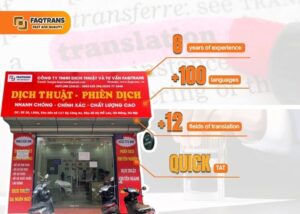
Benefits of using translation and notarization services at FAQTrans
FAQTrans ensures that you will receive a professionally formatted and accurately translated version of your legalized document. You can use our notarized and translated document to:
- Enroll in a school in Vietnam
- Apply for a job in Vietnam
- Reside in Vietnam
- Register for marriage in Vietnam
- Invest in projects in Vietnam
- Purchase property in Vietnam
….
Frequently asked questions about translation and notarization services for legalized documents in FAQTrans
If I have a foreign-issued document with no consular legalization/Apostille certificate, can I have that document translated and notarized in Vietnam?
This depends on your type of document. If your document is exempted from consular legalization under Vietnamese law (see the list in section II of this article), FAQTrans can translate and notarize it right away, as long as your document is issued and certified by a competent authority. Otherwise, your translation can only be certified by a translation company, which confirms that the content of translation is faithful to that of the original document.
If I have a digital consular legalization stamp/e-Apostille certificate, can I have that document translated and notarized in Vietnam?
Currently, a notary public in Vietnam can only certify your document when you present them with the original paper (the hard copy, not the photocopy or the digital file). This means you need to have a physical document as well as its physical consular legalization stamp/Apostille certificate in order to have it notarized in Vietnam. Otherwise, FAQTrans can only translate and certify your paper using our company’s seal.
Can FAQTrans translate and notarize documents that were legalized prior to September 11, 2026?
We do. Documents legalized prior to September 11, 2026 are still valid in Vietnam. You can absolutely ask us for a certified copy or a notarized translation of such documents.
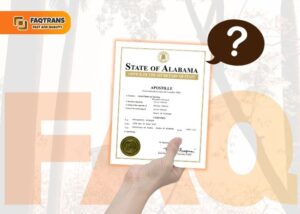
For further questions related to legalization, translation, or notarization, please contact FAQTrans via hotline, email, or Facebook
Consular legalization can be a time – consuming process, but once you have it done, you can easily use it in Vietnam. You can leave the translation and notarization that come afterwards to FAQTrans. Just simply contact us via our Facebook page, email (baogia.faqtrans@gmail.com), or hotline (+84963 029 396) to request our services.


